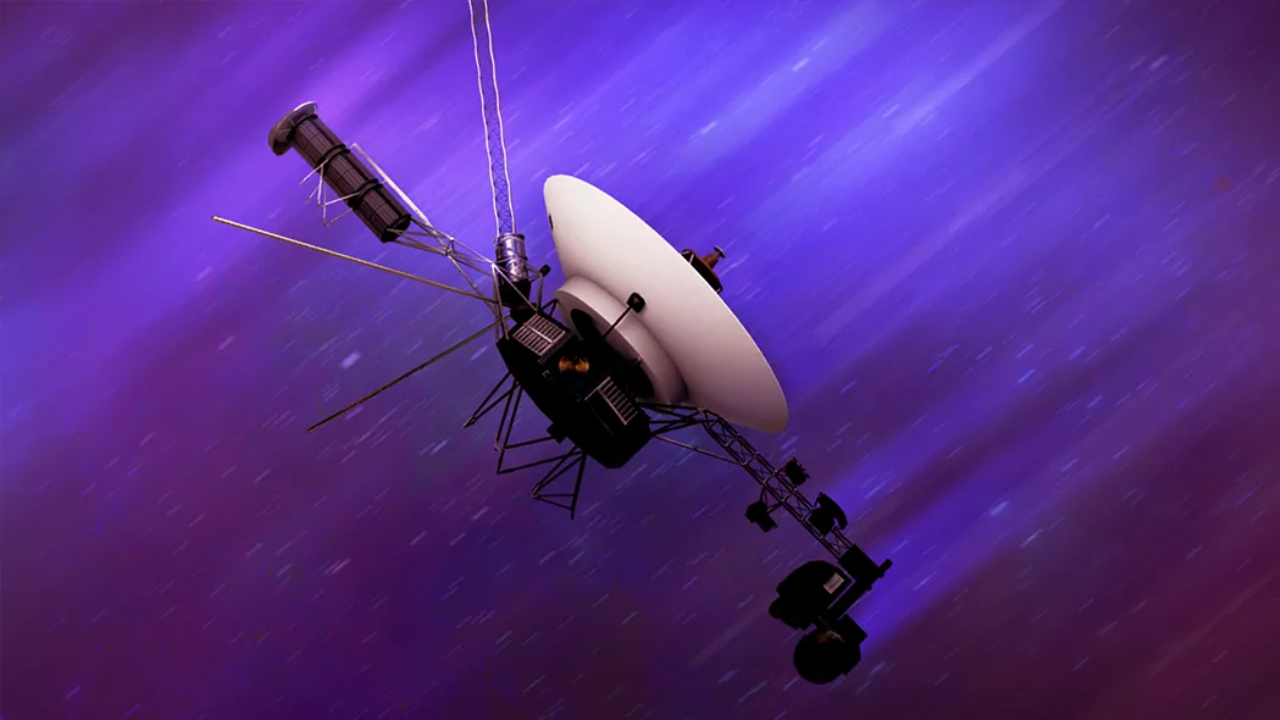
NASA’s twin Voyager spacecraft have revealed surprising truths about the farthest reaches of our solar system. Nearly 15 billion miles from Earth, Voyager 1 and Voyager 2 journeyed beyond the planets, crossing boundaries once thought to be understood.
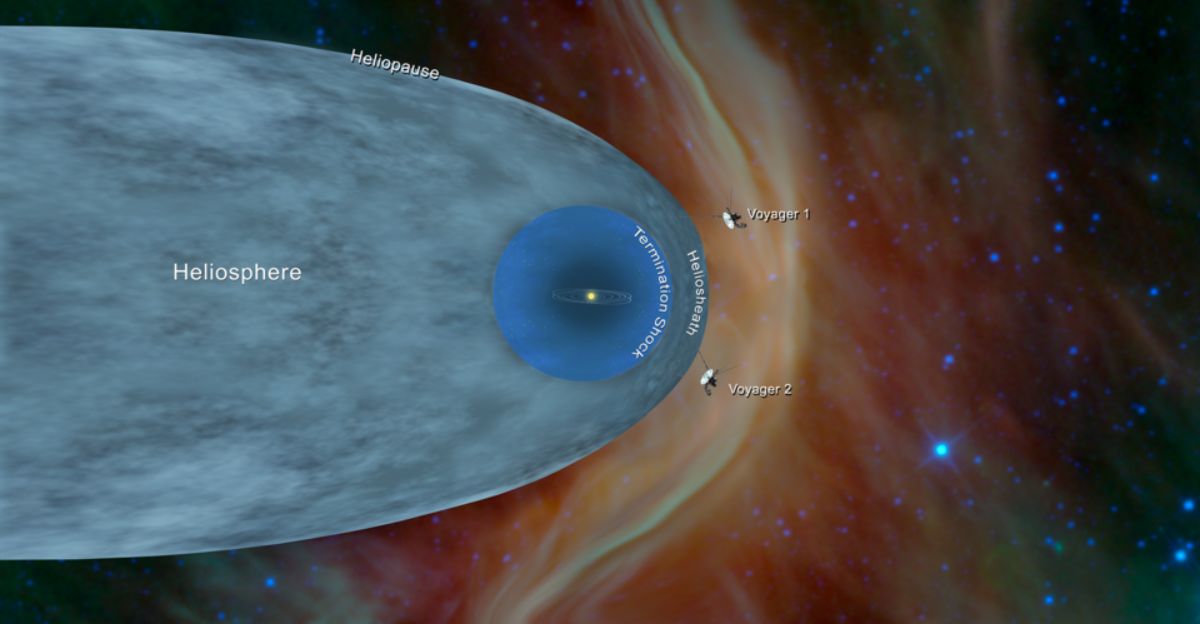
In November 2018, Voyager 2 entered the heliopause, where the Sun’s influence wanes and interstellar space begins. Its instruments measured plasma temperatures between 54,000 and 90,000 degrees Fahrenheit, more than twice as high as earlier predictions from computer models, which expected only 27,000 to 54,000 degrees.
Tom Krimigis of Johns Hopkins University noted the unexpected nature of this discovery, observing that the region is more energetic than previously thought. These findings have compelled scientists to reassess earlier models of how the solar wind interacts with the broader galaxy, revealing the edge of our solar system as both mysterious and turbulent.
As the Voyagers continued their epic path, each probe crossed different boundaries: the termination shock and then the heliopause. Until these missions, the exact nature and size of the heliosphere—a vast bubble created by the solar wind—was unknown.
Voyager 1 was the first to cross the heliopause in August 2012, becoming the first human-made object to enter interstellar space, followed by Voyager 2 six years later.
Measurements from both probes confirmed that the so-called “wall of fire” at the solar system’s edge is incredibly hot, and the plasma there is so sparse that, despite the extreme temperature, there’s almost no heat transferred to the spacecraft themselves.
This allowed the probes to survive the crossing and send valuable information back to Earth.
Surprising Science Beyond the Boundary
Beyond measuring temperature, the Voyager probes made several other discoveries after crossing into interstellar space.
Scientists had assumed that the magnetic field would sharply change direction at the heliopause, but both Voyagers found the magnetic fields on either side of the boundary to be nearly parallel, suggesting that solar and galactic magnetic environments are more connected than once believed.
The probes revealed complex leakage of energetic particles across the boundary, varying by location and contradicting earlier models that pictured a simple, solid edge. Voyager 2’s data showed more evidence of this particle leakage than Voyager 1, confirming that the heliopause is not uniform.
Additionally, both Voyagers observed significant changes in particle radiation. As Voyager 1 crossed the heliopause, there was a notable increase in the number of cosmic rays—a 9.3% jump—and a sharp drop in solar-made particles.
The heliopause also serves as a shield against cosmic rays from distant stars, thereby protecting the solar system from harsh interstellar radiation. These new insights are not just rewriting textbooks; they’re essential for planning future missions that may travel even farther into space.
Adapting to the Shifting Frontier
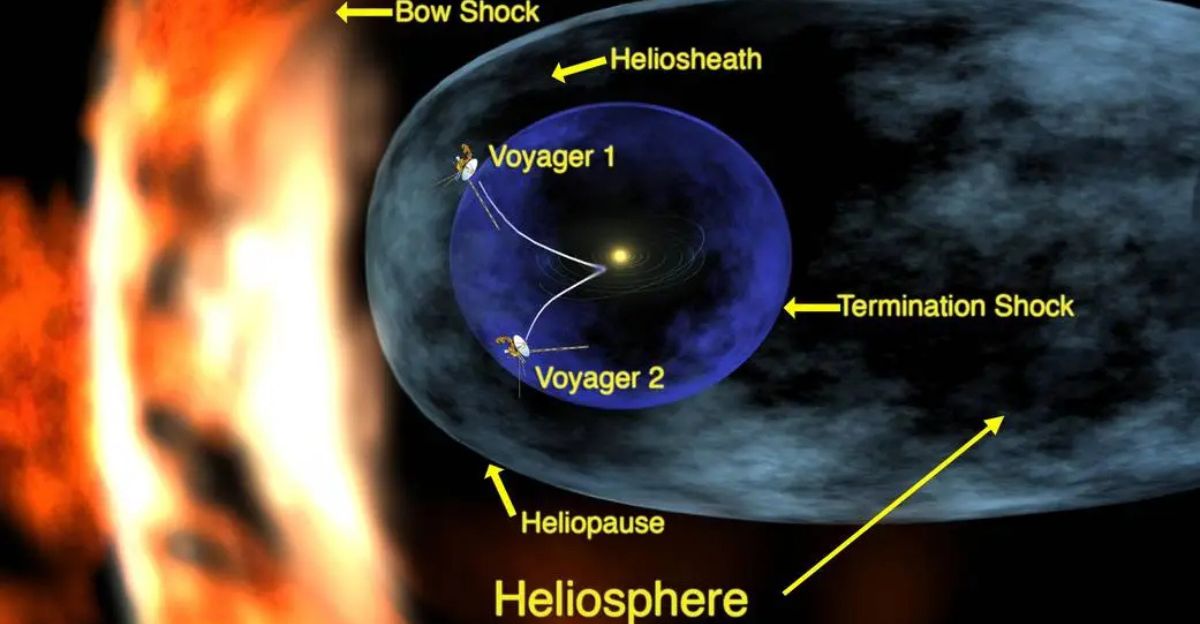
The boundary of our solar system is not fixed. The heliopause expands and contracts in response to the Sun’s 11-year cycles. During periods of high solar activity, the boundary expands outward; during quiet periods, it contracts inward.
This variation explains why Voyager 1 and Voyager 2 crossed at different distances from the Sun. NASA’s IBEX spacecraft, orbiting Earth, has confirmed these shifts. The Voyagers adapt at the edge, providing the first direct evidence of interstellar space’s density, temperature, and magnetic conditions.
As the Voyagers travel, their plutonium generators lose around four watts annually. NASA must deactivate instruments to conserve the most essential sensors. Despite these limitations, the Voyagers still send data, albeit at a rate of only 160 bits per second.
Their radio signals travel such vast distances that they take up to 23 hours to reach Earth. No other spacecraft will reach the heliopause for decades. The Voyagers’ endurance is legendary.
When they fall silent, they will continue through interstellar space, carrying humanity’s message to the stars—a testament to our quest to understand the universe.